Poster of Rimbaud
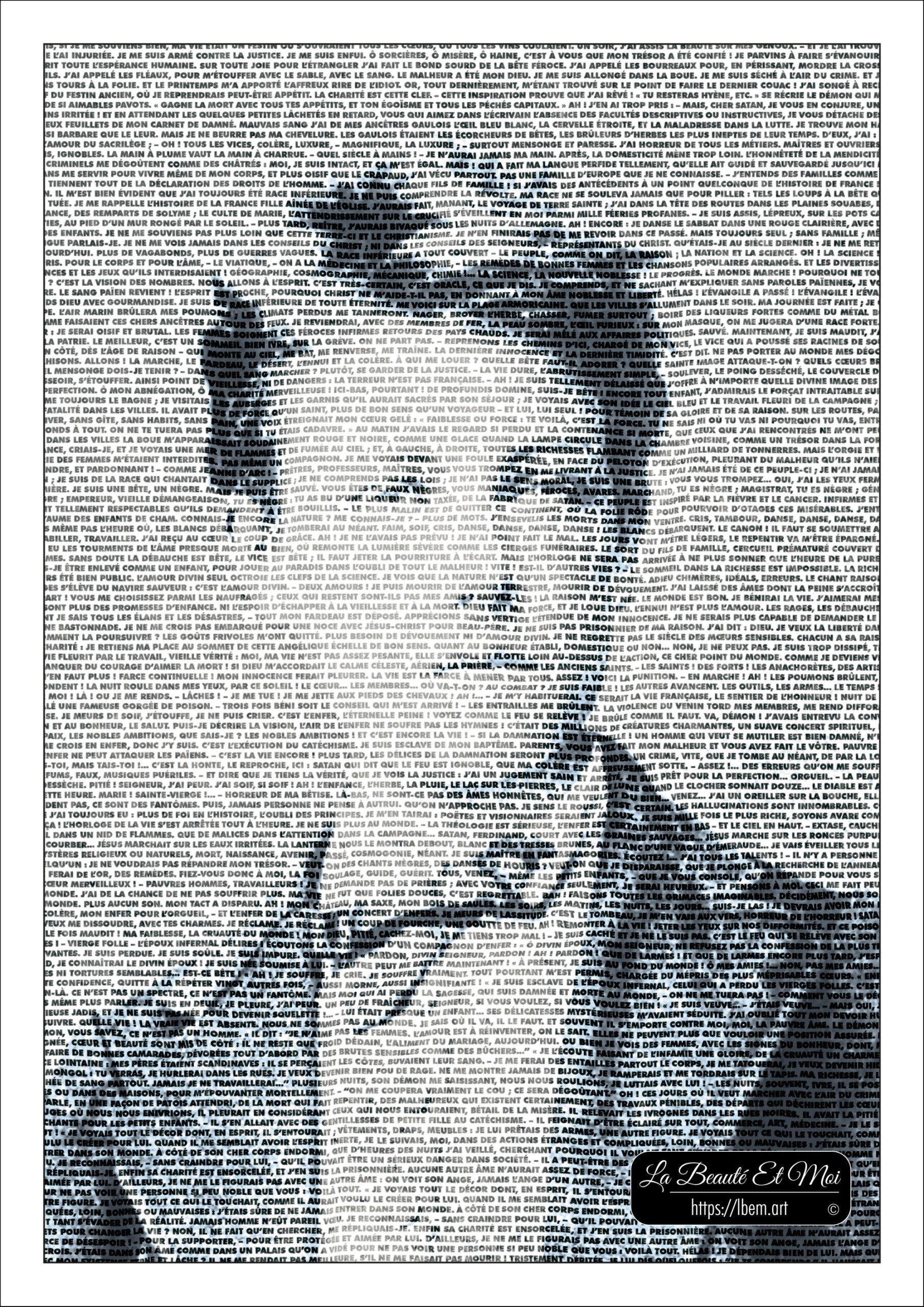
Arthur Rimbaud (1854-1891) is probably the greatest french poet, having revolutioned poetry with his colorful, visionary, playful and creative style, in his works written between the age of 15 to around 20 years old.
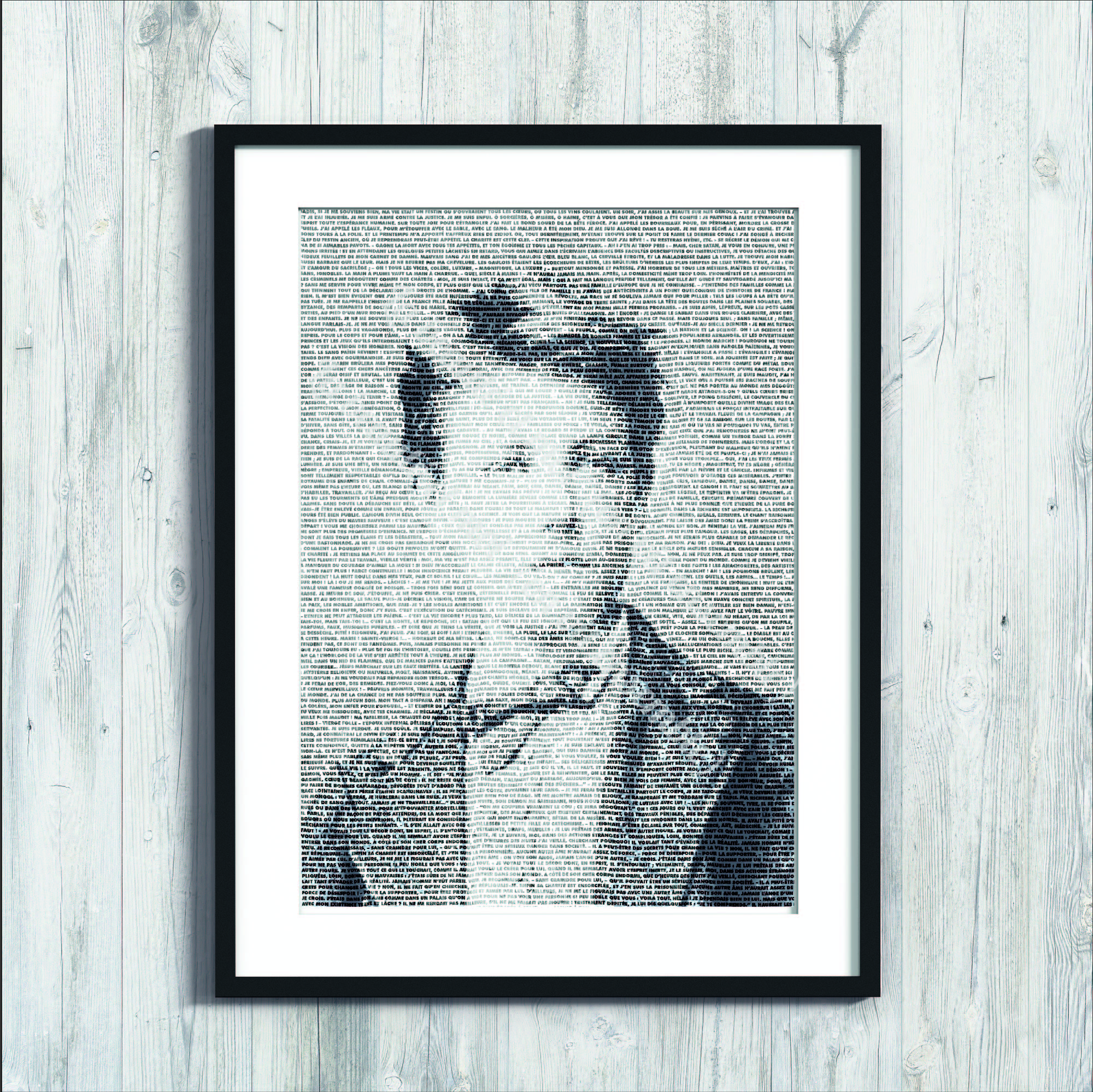
On those printable posters, he is portrayed through the beginning of the text of one of his major poetic works, Une saison en enfer (A season in hell).
The posters are downloadable and printable as JPG files, in white and black CMYK, 300dpi, in A4 and A3 formats.
Do you prefer to have it printed on metal? Then buy the Rimbaud poster from Displate
Rimbaud’s biography
The “man with the soles of wind” was born in 1854 in Charleville, to a peasant mother and an infantry captain father, who definitely forgets to come home 6 years later.
The child shows great intelligence very early on, winning numerous awards for excellence in literature, Latin version and theme.
At 15 he sent his first poems to the Parnassian poet Théodore de Banville, who answered him. He developed friendships with his rhetoric teacher, Georges Izambard, and an older comrade, Ernest Delahaye.
At 16, during the war against Prussia, Rimbaud ran away and tried to go to Paris where he was arrested, detained, and barely saved by Izambard. He ran away again a month later, first to Brussels and then to Izambard in Douai. He ran away a third time in February 1871, this time to Paris, just before the Commune, which he then supported in spirit. He then writes the famous “letter of the seer” in which he intends to revolutionize poetry.
He establishes an epistolary relationship with the poet Paul Verlaine, who invites him to Paris, where he goes and becomes acquainted with the literary milieu, which he upsets by its excesses. In Brussels and then in London, the relationship with Verlaine becomes romantic, until the day Verlaine decides to go back to his wife and shoot Rimbaud twice.
In 1873, in the family rock farm, Rimbaud wrote Une saison en enfer which recounts this tumultuous period, then returned to London with the poet Germain Nouveau, and put into shape the prose poems that would become Les Illuminations.
He then left to study German in Stuttgart, then Italian in Italy from where, victim of sunstroke, he was repatriated to Marseille. He then enlisted in the Dutch army and left for India, from where he deserted and returned to a Scottish boat, before leaving for Germany, then Sweden, Denmark, then Cyprus.
In 1880 he embarked for Alexandria in Egypt and from there to Yemen, then to Harar where he lived from a painful activity as a caravan trader. Frequently ill during all these years of wandering, he eventually succumbed, in 1891, at the age of 37, to generalized cancer, after having a leg amputated in Marseille.
At first classical and influenced by Parnassus and Charles Baudelaire, his poetics go through a series of strong breaks:
- between 1870 and 1872, he explores new, more subversive themes and innovates through linguistic inventiveness, strewing his verses with neologisms and discoveries
- in 1872, his “last lines” which he would have liked to call “nil studies” testify to a completely new, nonconformist conception: fuzzy themes, succession of images, sentences without verbs, fragments or flashes …
- he also invented the first free verses (neither necessarily rhymed, nor regular in number of syllables) of French literature with the poems Marine and Mouvement
- A Season in Hell also innovates by its mix between poetry and novel through a very colorful poetic prose.
- With the Illuminations, he considerably advances the genre of the prose poem, previously illustrated by those of Baudelaire and Aloysius Bertrand (Gaspard de la nuit …), with visionary and enigmatic texts, leaving a large place for the interpretation
Arthur Rimbaud, who hardly published anything during his lifetime, remains one of the major authors in the French language.
Put some poetry on your walls!


Karen Merryl –
Yes, definitely the best french poet ever!